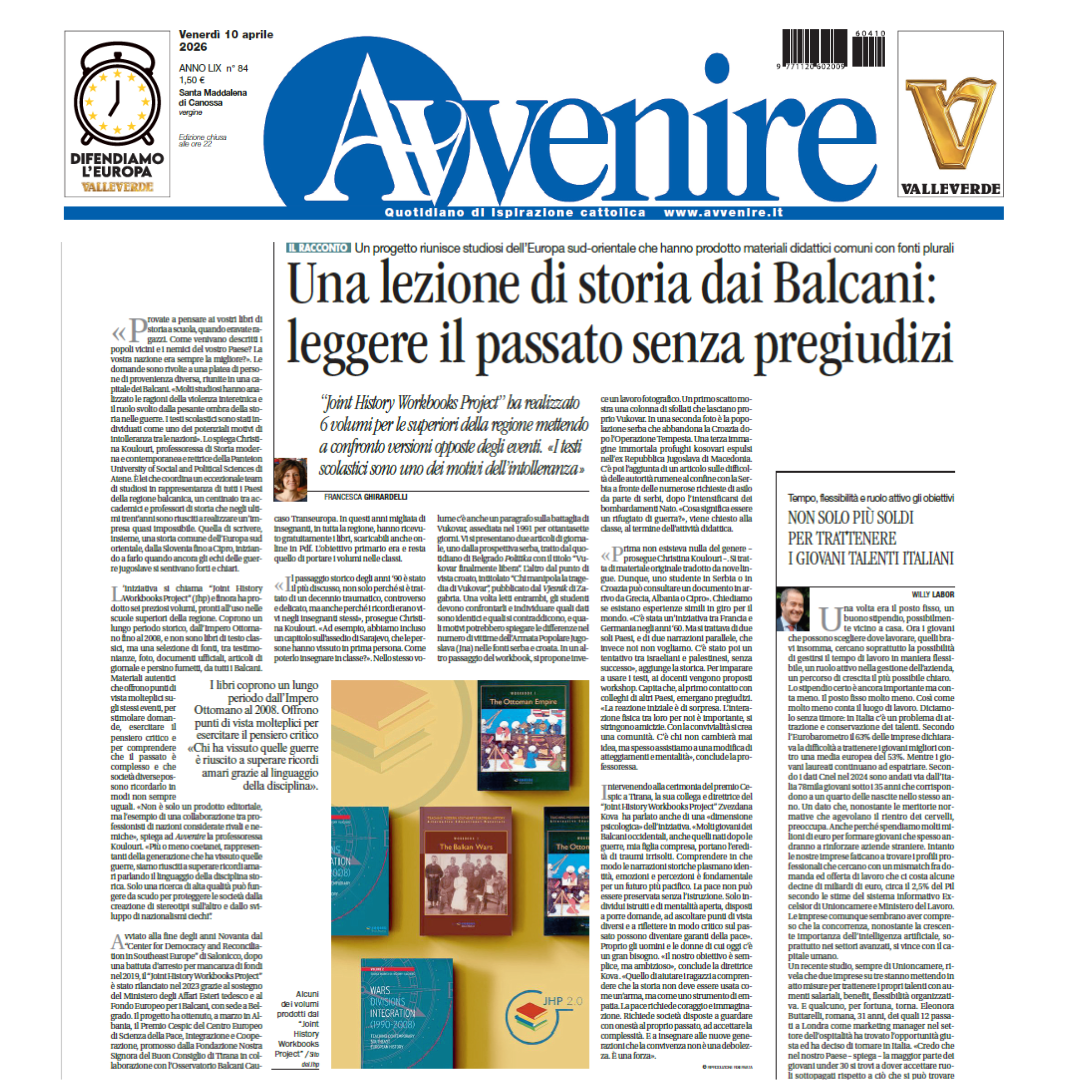
JHP project brings together scholars from Southeast Europe who have produced shared educational materials using multiperspective sources. The “Joint History Workbooks Project” has created six volumes for high schools in the region, comparing opposing versions of historical events.
«Try to think back to your history books in school when you were young. How were neighboring peoples and your country’s enemies described? Was your nation always the best?» These questions are addressed to an audience of people from diverse backgrounds, gathered in a Balkan capital.
«Many scholars have analyzed the reasons for inter-ethnic violence and the role played by the heavy shadow of history in wars. School textbooks have been identified as one of the potential causes of intolerance between nations,» explains Christina Koulouri, Professor of Modern and Contemporary History and Rector of the Panteion University of Social and Political Sciences in Athens. She coordinates an exceptional team of scholars representing all countries in the Balkan region—about a hundred academics and history professors who, over the last thirty years, have managed to achieve an almost impossible feat: writing a common history of Southeast Europe, from Slovenia to Cyprus, starting the work while the echoes of the Yugoslav wars were still loud and clear.
The initiative is called the “Joint History Workbooks Project” (JHP) and has so far produced six valuable volumes, ready for use in the region’s high schools. They cover a long historical period, from the Ottoman Empire to 2008. These are not classic textbooks, but a selection of sources—including testimonies, photos, official documents, newspaper articles, and even comic strips—from across the Balkans. These authentic materials offer multiple points of view on the same events to stimulate questions, exercise critical thinking, and foster the understanding that the past is complex and that different societies may remember it in ways that are not always identical.
«It is not just a publishing product, but an example of collaboration between professionals from nations considered rivals and enemies,» Professor Koulouri explains to Avvenire. «As peers and representatives of the generation that lived through those wars, we managed to overcome bitter memories by speaking the language of historical discipline. Only high-quality research can act as a shield to protect societies from the creation of stereotypes about “the other” and the development of blind nationalism.»
Development and Recognition
Launched in the late 1990s by the “Center for Democracy and Reconciliation in Southeast Europe” (CDRSEE) in Thessaloniki, the project saw a setback due to a lack of funds in 2019 but was relaunched in 2023 thanks to support from the German Federal Foreign Office and the European Fund for the Balkans, based in Belgrade. In March, in Albania, the project received the Cespic Award from the European Center for Peace Science, Integration and Cooperation, promoted by the Our Lady of Good Counsel Foundation in Tirana in collaboration with the Osservatorio Balcani Caucaso Transeuropa. Over the years, thousands of teachers across the region have received the books for free, which are also available for download online in PDF format. The primary goal remains bringing these volumes into the classroom.
Methodology: Confronting Trauma
«The historical transition of the 1990s was the most debated, not only because it was a traumatic, controversial, and delicate decade, but also because memories were still vivid for the teachers themselves,» Koulouri continues. «For example, we included a chapter on the Siege of Sarajevo, which people experienced firsthand. How can that be taught in class?»
In the same volume, there is a section on the Battle of Vukovar, which was besieged for eighty-seven days in 1991. It presents two newspaper articles: one from the Serbian perspective, taken from the Belgrade daily Politika with the title “Vukovar Finally Free,” and the other from the Croatian point of view, titled “Who is Manipulating the Tragedy of Vukovar,” published by Vjesnik in Zagreb. Once students have read both, they must compare them and identify which data are identical and which contradict each other, as well as what reasons might explain the differences in the number of JNA (Yugoslav People’s Army) victims between the Serbian and Croatian sources.
In another passage of the workbook, a photographic exercise is proposed:
-
The first shot shows a column of displaced persons leaving Vukovar.
-
A second photo shows the Serbian population leaving Croatia after Operation Storm.
-
A third image captures Kosovar refugees expelled to the former Yugoslav Republic of Macedonia. There is also an article on the difficulties faced by Romanian authorities at the border with Serbia due to numerous asylum requests from Serbs following the intensification of NATO bombings. «What does it mean to be a war refugee?» the class is asked at the end of the activity.
«Nothing like this existed before,» Koulouri notes. «This is original material translated from nine languages. Therefore, a student in Serbia or Croatia can consult a document coming from Greece, Albania, or Cyprus.»
Changing the Mindset
When asked if similar experiences exist elsewhere in the world, Koulouri responds: «There was an initiative between France and Germany in the 1960s. But that involved only two countries and two parallel narratives, which is not what we want. There was also an attempt between Israelis and Palestinians, but without success.»
To learn how to use the texts, workshops are offered to teachers. Sometimes, prejudices emerge during the first contact with colleagues from other countries. «The initial reaction is surprise. Physical interaction between them is important to us; friendships are formed. Through conviviality, a community is created. Some will never change their minds, but we often witness a change in attitudes and mindsets,» the professor concludes.
Speaking at the Cespic award ceremony in Tirana, her colleague and director of the “Joint History Workbooks Project,” Zvezdana Kovač, also spoke of the «psychological dimension» of the initiative.
«Many young people in the Western Balkans, even those born after the wars—including my daughter—carry the legacy of unresolved traumas. Understanding how historical narratives shape identities, emotions, and perceptions is fundamental for a more peaceful future. Peace cannot be preserved without education. Only educated and open-minded individuals, willing to ask questions, listen to different points of view, and reflect critically on the past, can become guarantors of peace.»
These are exactly the men and women who are so greatly needed today. «Our goal is simple yet ambitious,» concludes Director Kovač. «To help young people understand that history must not be used as a weapon, but as a tool for empathy. Peace requires courage and imagination. It requires societies willing to look honestly at their own past and accept its complexity. And to teach new generations that coexistence is not a weakness. It is a strength.»