Joint History Lab in Podgorica brings together youth from the region
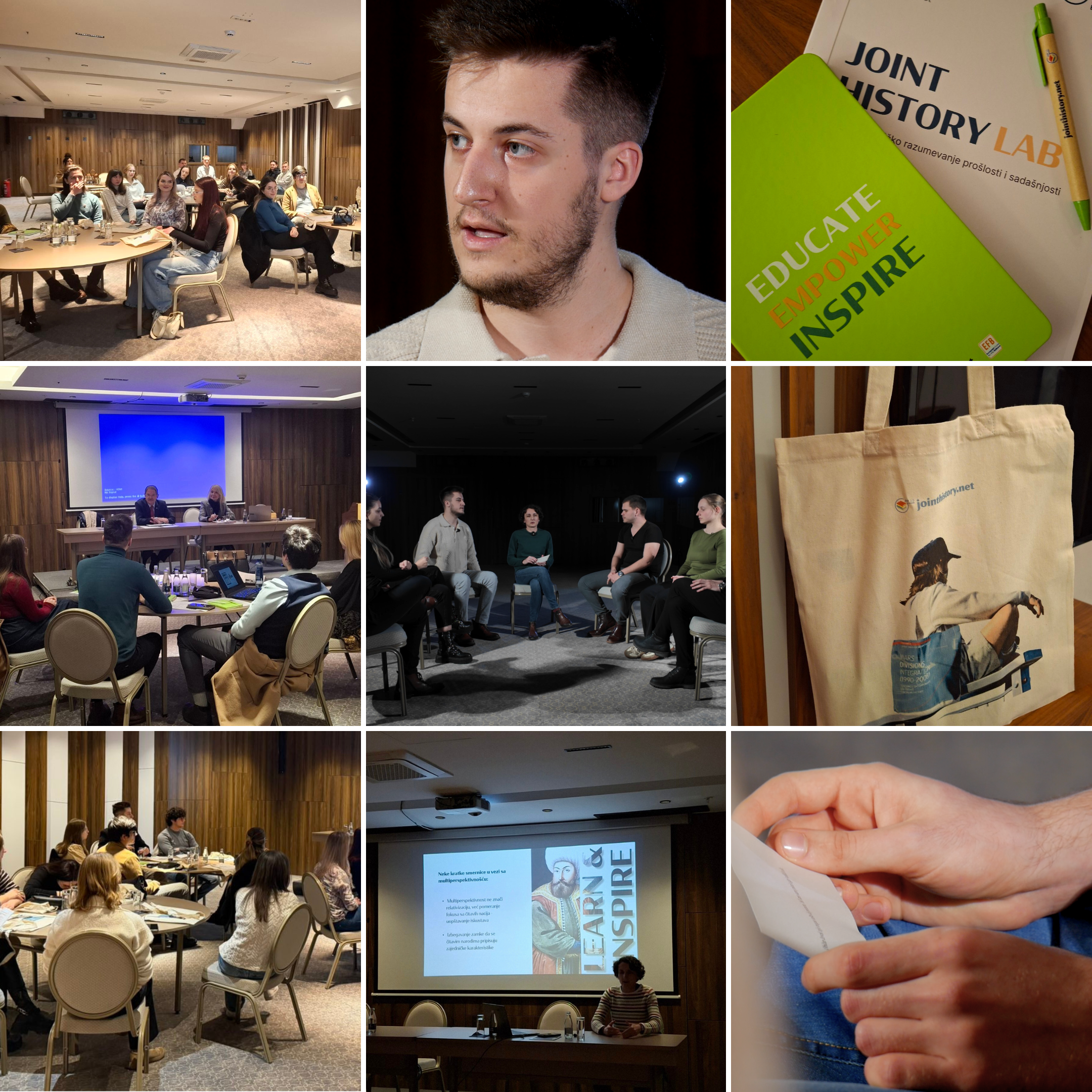
Multiperspectivity is the key to overcoming the legacy of the 1990s—this is the main conclusion of the “Joint History Lab” Winter School, held in Podgorica last week. The Winter School gathered young people from Bosnia and Herzegovina, Montenegro, Croatia, and Serbia. Over the course of four days, participants had the opportunity to speak with historians, psychologists, and media and communication experts to more easily recognize manipulation when learning about the most sensitive topics from the region’s history and recent past. Young people between the ages of 18 and 25, with diverse professions and interests, were able to hear why it is important to maintain a critical attitude towards reality. Through interactive workshops, they learned why the methodology of multiperspectivity is useful and applicable, how to deal with the traumas of the 90s, and why media literacy is essential.
The Ambassador of the Federal Republic of Germany to Montenegro, Mr. Peter Felten, also spoke with the participants from the region. The young people were interested in the model of Germany’s educational system after the Second World War and the country’s perception regarding the events in the countries of the region. Speaking about the imperative of confronting the past and incorporating the wars of the 90s into history textbooks, Ambassador Felten also discussed the European perspective of the region, especially Montenegro, and the values promoted by the EU that the countries of the region should adopt.
Multiperspectivity as the foundation for understanding the past and present
The central theme was the application of multiperspectivity through the Joint History Books, which was discussed by historian Sanja Radović. She emphasized that history requires examining different perspectives, as opposed to a single dominant national narrative that demands uniform alignment. High school history teacher Igor Radulović spoke about methods for teaching controversial topics from the past, highlighting the importance of studying subjects like the wars of the 1990s. It is important, among other things, for students to recognize the flaws of black-and-white narratives and develop tools for understanding the society they live in. In these workshops, young people were encouraged to view historical events from multiple angles in order to overcome the narrow national prism that often oversimplifies a complex reality. Furthermore, using examples from the 1990s wars, they understood how propaganda and the manipulation of erasing different voices turn former neighbors into enemies. During practical exercises, they were given the opportunity to use primary historical sources, such as personal testimonies and documents, to make difficult topics less abstract and easier to comprehend.
Confronting collective trauma and divisions
What particularly set this Winter School apart was the integration of a psychological approach into the understanding of historical processes. Psychologist Ana Mirković led a workshop on understanding collective traumas and reconciliation mechanisms. She pointed out that trauma does not solely remain with those who experienced it directly, but is passed down to younger generations through family stories, as well as through silence regarding painful topics. Recognizing defense mechanisms, such as projection and polarization, is crucial for more conscious participation in social dialogue. Psychologist Radoje Cerović addressed the role of emotions and identity in generating conflict. Participants had the opportunity to analyze how, under conditions of perceived threat, attention narrows and society divides into “us” and “them”. Cerović emphasized that dehumanization rarely begins with extreme violence, but rather with a subtle change in language and distancing that is presented to the public as a necessity.
Through the psychological workshops, participants gained a deeper understanding of how collective traumas and feelings of threat are transmitted across generations, shaping identity and causing social divisions. They had the chance to see how unconscious defense mechanisms can be recognized, along with subtle forms of dehumanization that start not with extreme violence, but with changes in language and distancing. The main focus was on adopting techniques that enable creating a crucial pause between a strong emotional impulse and a rational response, thus choosing conscious communication over automatic reaction and conflict.
Defense against the manipulation of the past
To fully deconstruct these narratives, the program also included two key workshops dedicated to media literacy. Prominent journalist Vladan Mićunović led a workshop on recognizing the manipulation of the past in traditional media. They analyzed how history is instrumentalized for political mobilization and how documented facts are often maliciously equated with ideological interpretations. Social media expert Enes Pućurica held a workshop focused on recognizing deception in the digital world. Participants learned how history is tailored for clicks and how modern AI technologies can generate convincing but fake historical materials (such as deepfake photographs), emphasizing the importance of digital self-defense.
The media workshops provided participants with tangible tools to recognize the misuse of the past in both traditional and digital media. Participants analyzed how documented historical facts are intentionally and selectively used for political mobilization, thereby blurring the line between science and ideology. Special attention was paid to mastering “digital self-defense”—spotting deceptive historical materials generated by artificial intelligence, and adopting methods such as lateral reading to verify the true origin of information.
As the crowning achievement of the event, the Winter School concluded with an interactive debate and the recording of “Viewpoint” video exercises, where participants practically applied the knowledge they had acquired. The debate will soon be available online.
We also invite you to read our methodological guide from the workshops.