
TIRANA, March 11 – The Joint History Project (www.jointhistory.net) has been awarded this year’s Peace Prize by the European Centre for Peace Science, Integration and Cooperation (CESPIC) in Tirana, in collaboration with the Balkan-Caucasus Trans-European Observatory (OVCT) based in Trento.
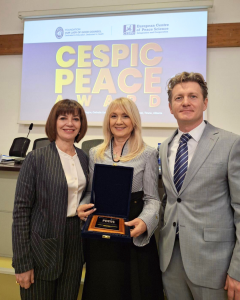
The award was presented today at a ceremony held at the Catholic University “Our Lady of Good Counsel” in Tirana. The prize recognizes individuals and organizations that have made outstanding contributions to strengthening international cooperation, educating youth about peace, and promoting dialogue among different communities.
On behalf of the project, the award was received by Professor Christina Koulouri of the Panteion University in Athens, Chair of the Project’s Scientific Board, and Project Director Zvezdana Kovač. The project is implemented in cooperation with the European Fund for the Balkans in Belgrade, with financial support from the German Federal Foreign Office.
“Only educated, curious, and open-minded people, ready to critically reflect on the past and understand different perspectives, can truly guarantee peace,” Kovač emphasized in her acceptance speech. She added that the creators of the Joint History Project particularly value the award’s recognition of the importance of youth education as the foundation of peace.
Professor Koulouri noted that more than 100 historians from across the region have worked on this complex task. “Our approach in these textbooks has been to maintain a distance from both heroization and victimization, and to introduce students to war experiences as a complex phenomenon and, above all, as a shared human experience,” Koulouri explained.
The Joint History Project was launched in the late 1990s, during the wars in Yugoslavia.
“At that time, the very idea that historians from all corners of Southeast Europe could jointly produce teaching materials describing the past from different perspectives seemed almost impossible. However, thanks to the enthusiasm of a large number of history teachers and other experts, the idea became a reality,” Kovač pointed out.
The content of the joint history textbooks is available on the project’s website (www.jointhistory.net) and social media. New regional educational programs are underway, including psychological workshops on recent traumas. The project’s latest scientific conference focused on the past and future of borders in Southeast Europe.